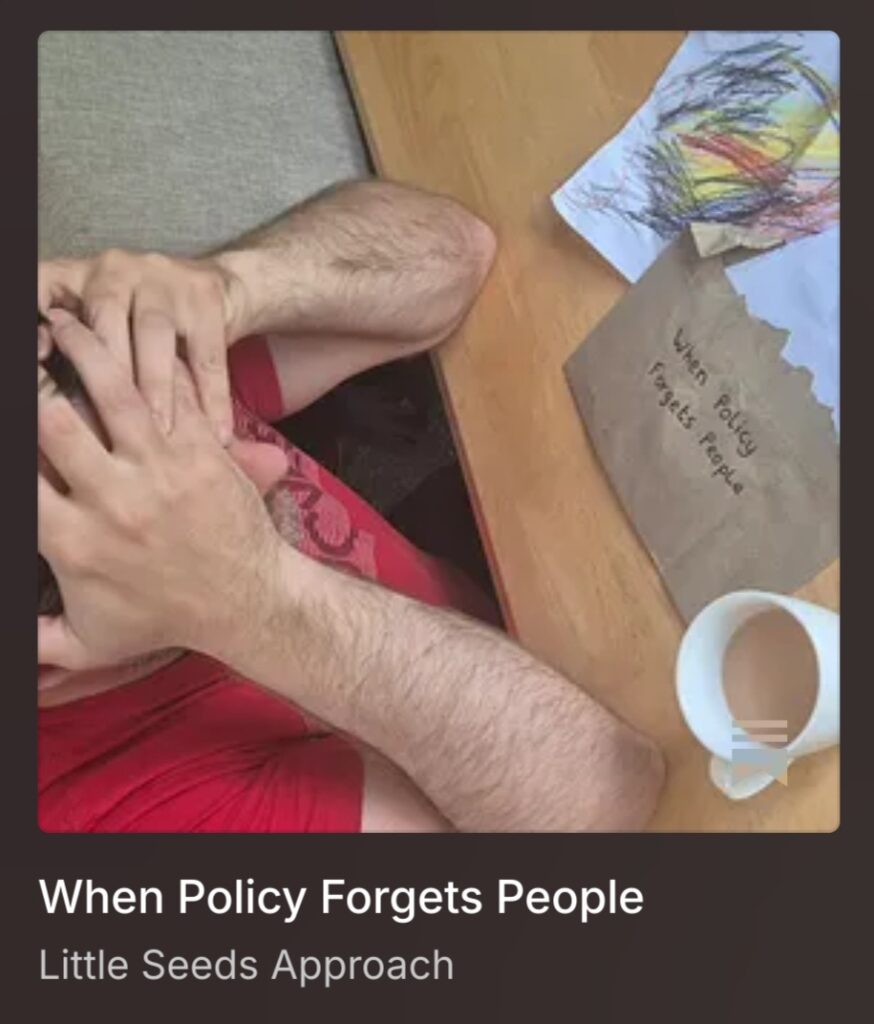
When Policy Forgets People
The human cost of systems designed at a distance
Thomas Mountney, MA Early Childhood Studies
Early Childhood Specialist | Conditions Lens Framework
Developed through interdisciplinary observation across early childhood development, ecology, policy, regulation, lived experience, community systems, adult wellbeing and environmental conditions.
Table of Contents
- Introduction: Policy as a Living Condition
- Defining Policy Through the Conditions Lens
- Distance, Design and Lived Reality
- Compliance, Care and the Conditions Around Adults
- When Support Becomes Pressure
- Participation, Trust and the People Closest to Life
- Conditions Before Outcomes
- The Human Cost of Distant Systems
- Returning Policy to Life
- Concluding Reflection
- References
Introduction: Policy as a Living Condition
A letter on the kitchen table can change the atmosphere of a home.
Before it is even opened, it is already felt. It lands into the tiredness of the day, into the bills already waiting, into the child asking for attention, into the parent trying to stay calm, and into the quiet calculation of what can be managed and what cannot.
This is something policy can forget.
Policy is often written as though it lives on paper. It is drafted through strategies, frameworks, regulations, eligibility criteria, implementation plans and administrative processes. Yet once policy leaves the page, it does not remain abstract. It enters people’s lives.
Within the Conditions Lens, policy can be understood as one of the wider conditions shaping human behaviour, wellbeing, trust, participation, access and stability. Policy does not simply organise systems from a distance. It becomes part of the environment people must live within, respond to, adapt around, and sometimes survive against.
This matters because people do not experience policy in isolation. They experience it inside homes, bodies, relationships, workplaces, communities, histories, fears, hopes and responsibilities. They experience it while already carrying pressures that no form, framework or strategy can fully measure.
At its best, policy can protect. It can organise support, guide services, create fairness, strengthen accountability, and help society care beyond the limits of individual goodwill. It can create the conditions through which children, families, workers, communities and vulnerable groups are better supported.
However, policy can also drift from the lived realities it is intended to serve. When policy is designed too far from lived experience, it can begin to mistake design for reality. It can mistake compliance for care. It can mistake availability on paper for access in real life. It can ask people to meet requirements without first asking what conditions they are living within.
This is not a rejection of policy. It is a call to bring policy closer to life.
If childhood is shaped by conditions, if behaviour is shaped by conditions, if adulthood is shaped by conditions, and if identity forms through conditions, then policy must also be understood through conditions. This paper therefore extends the Conditions Lens from the personal and developmental into the systemic.
The question, then, is not only whether policy works on paper. The question is what kind of condition it becomes in people’s lives.
Does it create trust, dignity, access, stability and support?
Or does it create pressure, fear, confusion, exclusion and withdrawal?
When policy does not understand the conditions into which it lands, even good intentions can become another weight for people to carry. This is what happens when policy forgets people: not always through cruelty, but often through distance.
If policy is to truly support people, it must be judged not only by how well it is written, implemented or measured, but by how it lands in human lives.
Defining Policy Through the Conditions Lens
Within the Conditions Lens, conditions refer to the repeated environmental, relational, emotional, cognitive, social, economic and administrative realities that shape how people live, respond, adapt, participate and flourish over time.
Policy is one of these conditions.
Although policy is often understood as a document, rule, regulation, strategy or administrative process, it does not remain separate from everyday life once implemented. It becomes part of the environment people must live within. It shapes what people can access, what choices feel possible, how much trust they carry, how safe they feel, and whether systems are experienced as supportive, threatening, confusing, reachable or distant.
From this perspective, policy is not neutral. It does not land into identical lives.
A requirement that feels manageable to one person may feel overwhelming to another. A support that appears accessible to one family may remain practically unreachable to another. A process that feels clear to someone with time, confidence and stability may feel impossible to someone already living within pressure, uncertainty or fear.
This is why a Conditions Lens matters. It asks not only what a policy intends to do, but what it creates once it enters real life.
At its best, policy can create conditions of stability, fairness, protection, access and support. It can reduce uncertainty, organise care, strengthen rights and make life more manageable.
But when policy is disconnected from lived experience, it can become another force acting upon people rather than with them. It can become another demand, another form, another deadline, another threshold, another uncertainty, or another reason to feel that the system was never truly designed around human life.
Policy must therefore be judged by more than its intention, wording or administrative design. It must also be judged by the conditions it creates.
Because policy becomes part of the soil people are trying to grow in. If that soil is filled with fear, pressure, confusion and impossible demands, we should not be surprised when people struggle to thrive.
Distance, Design and Lived Reality
Within the Conditions Lens, distance matters because it changes what systems are able to see.
When policy is designed far from lived experience, human life can begin to appear simpler than it is. Complexity becomes reduced into categories. Pressure becomes reduced into eligibility. Need becomes reduced into criteria. Participation becomes reduced into engagement.
This does not mean categories are useless. Systems often need language, structure and classification in order to organise support, allocate resources, protect people fairly and make decisions consistently.
But categories are not the whole person.
A family is more than a household.
A child is more than an enrolment.
A worker is more than a role.
A childminder is more than a provider.
A displaced person is more than a status.
A community is more than an application.
A life is more than a file.
When policy moves too far from the ground, it can lose the texture of real life. It cannot always see the tiredness in someone’s voice, the fear behind a question, the unpaid labour already being carried, the shame of asking for help, the emotional effort required to stay calm, or the quiet courage it takes to keep going.
Life is not lived from the distance of a policy document. It is lived close up.
It is lived in homes, workplaces, classrooms, services, waiting rooms, kitchens, cars, communities and bodies. It is lived through tired mornings, anxious questions, difficult choices, school runs, caring responsibilities, transport problems, bills, appointments, forms, phone calls and quiet worries that are rarely visible inside a system.
When these conditions disappear from view, policy can begin to make demands as if they are not there. From a distance, it may seem reasonable to ask people to engage more, train more, prove more, report more, apply more, adapt more and comply more. But inside real life, every new requirement lands on top of what is already being carried.
This is why policy distance matters. Distance does not only separate policymakers from people. It separates decisions from the conditions those decisions will enter.
It is also important to recognise that policymakers themselves operate within conditions. Decisions are rarely made in complete freedom. They may be shaped by political timelines, budget limits, legal advice, departmental structures, public pressure, media reaction, risk avoidance, data requirements and the need to produce measurable outcomes.
From a Conditions Lens perspective, this matters because policy distance is not only created by individuals failing to care. It can also be created by systems that make closeness difficult. A policymaker may intend to support people, but still work within conditions that reward speed, certainty, compliance, measurable outputs and administrative clarity over slower forms of listening, relationship and lived understanding. In this way, even those designing policy may become shaped by the same wider system that later shapes the people expected to live with the policy.
This does not remove responsibility. But it changes the question.
Instead of asking only whether policymakers care, the Conditions Lens asks what conditions allow policymakers to remain close enough to life while making decisions that affect it.
Once distance takes hold, systems can begin to misread human responses. Non-engagement may be interpreted as resistance. Anxiety may be interpreted as difficulty. Exhaustion may be interpreted as lack of motivation. Survival may be interpreted as failure. Withdrawal may be interpreted as unwillingness, rather than as a signal that the conditions around participation are too heavy.
From a Conditions Lens perspective, this matters because behaviour is rarely separate from environment. How people engage with policy is shaped by the conditions surrounding that engagement.
Perhaps people are not hard to reach. Perhaps the system is hard to access. Perhaps the language is too cold. Perhaps the process is too heavy. Perhaps the trust was never built. Perhaps the timing is wrong. Perhaps the person is already overwhelmed. Perhaps the support asks too much before it gives enough.
A person who is struggling does not always need another pathway.
Sometimes they need a bridge.
If policy is serious about improving lives, it must stop asking only why people are not reaching the system. It must also ask why the system is not reaching people.
Compliance, Care and the Conditions Around Adults
Within many modern systems, compliance has become one of the main ways care is evidenced.
Forms are completed. Procedures are followed. Requirements are checked. Reports are produced. These processes matter. They support accountability, transparency, safety, consistency and public responsibility. In work involving children, families, care, education, disability, housing, displacement and public services, standards are necessary.
The issue is not the existence of compliance.
The issue is what happens when compliance becomes mistaken for care itself.
A system can follow its own rules and still fail a person. A form can be completed while a need remains unmet. A service can meet requirements while the person standing in front of it feels unseen.
The issue becomes deeper when compliance does not simply evidence practice, but begins to drive it.
In many care and education settings, adults are not only thinking about the child, family or person in front of them. They may also be thinking about liability, inspection, documentation, complaints, safeguarding requirements, risk assessments and the possibility of getting something wrong. This reflects a wider tension in public service work, where frontline practitioners often have to translate policy into real-life decisions under pressure (Lipsky, 1980).
Some of this is necessary. Children need protection. Adults need clear responsibilities. Systems need safeguards.
But when fear becomes the atmosphere around practice, relationship can begin to move into the background.
A childcare worker may become more focused on avoiding mistakes than on being emotionally present. A childminder may begin to feel monitored rather than trusted. A teacher may hesitate before offering warmth because the system has taught them to think first about risk. A parent may begin to feel that every decision is open to judgement, comparison or failure.
In this way, compliance can become more than an administrative requirement.
It can become a condition shaping adult behaviour.
It shapes what adults notice, what they fear, how freely they respond, whether they feel trusted, and whether relationship feels safe.
This connects directly to the wider Conditions Lens. In Beyond Behaviour, behaviour is not treated as an isolated problem, but as a signal of the conditions surrounding the person. The same principle applies here. When an adult becomes cautious, defensive, withdrawn, emotionally guarded, overstretched or overly focused on procedure, this may also be signalling the conditions surrounding that adult.
In The Adult Architect, adults are understood as architects of childhood conditions. They shape the emotional atmosphere, pace, routines, boundaries, safety and relational environment children experience. But adults are also shaped by the pressures, expectations, policies, regulations, economic realities and emotional climates surrounding them.
This matters because it is not only educators who shape childhood. Parents, childminders, teachers, carers and communities all help shape the atmosphere children grow within.
If these adults are expected to create calm, responsive and emotionally secure conditions for children, then the conditions surrounding those adults must also be examined.
A parent cannot be endlessly pressured and then expected to remain endlessly patient. An educator cannot be surrounded by fear of liability and then expected to offer care with full emotional freedom. A childminder cannot be treated mainly as a compliance risk and then expected to feel trusted, confident and relationally open.
Policy therefore does not only shape paperwork.
It shapes the adults who shape the child’s world.
And when policy changes the conditions around adults, it can quietly change the conditions around children too.
From a Conditions Lens perspective, care does not emerge from paperwork alone. Care emerges from the conditions that make human responsiveness possible: time, trust, relationship, emotional safety, professional confidence and enough capacity to notice, listen, respond and adapt.
Without these conditions, care becomes difficult to sustain, no matter how well documented a system may be.
Policy, therefore, is not care in itself.
But policy can shape the conditions in which care either survives or disappears.
This does not mean systems should abandon standards, evidence or accountability. Without these, systems can become inconsistent, unfair, unsafe or misused. However, when compliance becomes the centre, people can be pushed to the edges.
The question becomes whether the form was completed, not whether the person was understood. Whether the requirement was met, not whether the condition was recognised. Whether the system can prove it acted, not whether the human being was actually helped.
This is one of the limits of paper-based systems. They can record what was done, but they cannot always reveal what was felt, what was feared, what was missed, or what became impossible because the conditions surrounding the person were never properly understood.
A document cannot raise a child. A framework cannot comfort an exhausted parent. A regulation cannot replace trust. A strategy cannot repair a broken relationship. A funding stream cannot create belonging unless it reaches people in ways they can actually use.
Within the Conditions Lens, the purpose of policy should not be to replace care with proof.
It should be to create the conditions in which care can happen more reliably, more fairly and more humanely.
When systems begin to protect their own procedures more carefully than they protect the people within them, something has gone wrong.
They have forgotten their purpose.
When Support Becomes Pressure
Support can exist on paper and still remain out of reach in real life.
This is one of the central problems of policy designed at a distance. A system may create a programme, pathway, grant, training course, referral process or support service and assume that availability is the same as access.
But availability is not the same as access.
Support only becomes meaningful when people have the conditions needed to reach it, understand it, trust it, use it and sustain engagement with it.
From a Conditions Lens perspective, this distinction matters deeply. A person does not approach support from a neutral place. They approach it from within the reality of their own life. They may be tired, anxious, under pressure, working long hours, caring for children, managing bills, navigating trauma, lacking transport, struggling with confidence, or already feeling judged by the system.
In these conditions, even well-intended support can become another demand.
A training programme may be useful, but not if the person has no time, childcare, energy or confidence to attend. A grant may be helpful, but not if the application process is too complex or the language too inaccessible. A regulatory pathway may aim to improve quality, but not if the people expected to engage with it are already under-resourced, fearful or overwhelmed.
This is how support becomes pressure.
Not because support is unnecessary.
But because the conditions around access have not been properly understood.
A system can point to the door and say it is open. But if the path to that door is blocked by fear, shame, time pressure, transport, paperwork, cost, digital exclusion, low confidence or lack of trust, then the support is not truly reachable.
It may be available.
But it is not accessible in any meaningful human sense.
This is how inequality can deepen quietly. The people with the most stability, confidence, time and resources may be best able to access support, while those under the greatest pressure may be least able to reach it. The system may appear fair because the same support exists for everyone, but the conditions surrounding people are not the same.
The same form does not land equally in every life.
The same deadline does not carry the same weight for every family.
The same requirement does not feel the same to someone already afraid of losing security, income, housing, care, belonging or future possibility.
When systems fail to recognise this, they can mistake equal provision for equal access.
But equal provision is not always enough.
A Conditions Lens asks a deeper question: what conditions make access possible?
This requires policy to look beyond the existence of support and towards the human realities surrounding engagement. Does the person have time, trust, understanding, capacity and practical means to participate? Do they feel safe asking for help? Do they believe they will be treated with dignity?
If the answer is no, then the support may exist only in theory.
And when support exists in theory but not in lived experience, people can be blamed for not accessing help that was never truly reachable to them.
This is where systems can become quietly cruel.
They create a pathway, but not the conditions needed to walk it.
They offer support, but not the trust needed to accept it.
They ask for engagement, but not with enough understanding of what engagement costs.
They measure uptake, but not the fear, confusion or exhaustion that may have kept people away.
In this way, policy can unintentionally create the very disengagement it later tries to solve.
It can create pressure, then wonder why people withdraw.
It can create complexity, then wonder why people do not engage.
It can create fear, then wonder why trust is missing.
From a Conditions Lens perspective, the question is not only whether support exists.
The question is whether support can be reached by the people who need it most.
Because support that cannot be reached does not reduce pressure.
It becomes part of it.
And when help becomes heavy, people may not move closer to the system.
They may move further away.
Participation, Trust and the People Closest to Life
If policy is to understand the conditions it enters, it must listen to the people already living within them.
The people closest to life often understand its conditions best. Parents understand the pressure inside homes. Childminders understand the rhythms of care in domestic spaces. Educators understand the emotional weight of daily practice. Communities understand the barriers in their own places. People living through uncertainty understand what instability does to the body. Those working directly with land, children, families or services often notice things that cannot easily be captured from a desk.
This does not mean lived experience should replace research, policy, professional knowledge or evidence. It means lived experience must be allowed to shape them. This aligns with capability-based approaches that understand development and justice not only through resources provided, but through what people are actually able to do and become within their real conditions (Sen, 1999; Nussbaum, 2011).
When policy excludes the people closest to the conditions, it may become more polished, more strategic, more measurable and more formally correct, while also becoming less wise.
Wisdom requires closeness.
It requires listening before designing. It requires humility before intervention. It requires asking before assuming. It requires seeing people as partners in understanding, not merely as problems to be managed.
Too often, participation happens too late.
People are invited to respond to structures they did not help shape. They are asked for feedback after the direction has already been chosen. Their voices may be gathered, summarised and acknowledged, while the deeper conditions they describe remain unchanged.
That is not true participation.
True participation means people help define the problem before the solution is designed.
It means the parent is not blamed for struggling, but asked what conditions are making family life harder. It means the childminder is not simply told how to improve, but asked what support would make improvement possible. It means the educator is not only asked to implement new requirements, but listened to about the pressure those requirements create in practice. It means the community is not expected to fit itself into a funding scheme, but supported to develop what is needed in its own place.
People should not be treated as barriers to policy.
They should be recognised as sources of understanding.
This matters because trust is also a condition.
People are more likely to engage with systems they believe understand them. They are more likely to participate when they feel respected, not judged. They are more likely to ask for help when they believe help will not be used against them.
Without trust, even good policy can struggle to land.
From a Conditions Lens perspective, this is not resistance for the sake of resistance.
It is adaptation.
People adapt to the systems they encounter. If a system repeatedly feels distant, punitive, confusing or suspicious, people may learn to protect themselves from it. If a system feels respectful, consistent, humane and reachable, people may gradually begin to trust it.
Policy therefore cannot demand trust.
It must create the conditions in which trust can grow.
This requires more than consultation. It requires relationship, time, feedback loops that genuinely change decisions, language people can understand, processes people can realistically complete, and supports designed around real capacity rather than ideal participation.
The people closest to life can often see where trust is missing. They can see where language becomes a barrier, where support is unreachable, where fear is growing, where a process looks simple on paper but becomes difficult in practice, and where the conditions are wrong.
Policy should not be something done to people.
It should be something shaped with them.
Not because this sounds kinder.
But because it makes policy wiser.
Conditions Before Outcomes
Outcomes matter.
But outcomes do not appear from nowhere.
They emerge from conditions.
This idea sits at the centre of the Conditions Lens. Whether we are looking at childhood, behaviour, adult wellbeing, identity, community participation or policy engagement, the visible outcome is rarely the whole story. It is usually the surface expression of deeper conditions that have been shaping what was possible over time.
A child’s behaviour may be the visible outcome, but the conditions may include tiredness, sensory overload, adult tone, emotional safety, timing, autonomy, hunger, noise, familiarity or relationship.
An adult’s exhaustion may be the visible outcome, but the conditions may include work pressure, economic strain, digital interruption, limited recovery, reduced community support, emotional labour and constant responsibility.
A community’s disengagement may be the visible outcome, but the conditions may include lack of trust, inaccessible processes, past disappointment, limited time, complex paperwork, unclear language or the feeling that decisions have already been made elsewhere.
Policy often focuses on outcomes because outcomes are easier to measure: engagement rates, compliance levels, applications submitted, training completed, services accessed, targets reached and reports produced.
These measurements can be useful.
But they do not always reveal the conditions that produced them.
Low engagement may not mean people do not care. It may mean the process was too heavy, the timing was wrong, trust was missing, language was inaccessible, fear was present, or the support did not feel reachable.
A failure to complete a requirement may not mean someone was unwilling. It may mean the conditions surrounding that person made completion unrealistic.
A family in crisis may not have suddenly failed. They may have been living for a long time within conditions that made stability harder and harder to maintain.
From a Conditions Lens perspective, policy must learn to look earlier.
Before the outcome.
Before the crisis.
Before the refusal.
Before the disengagement.
Before the burnout.
Before the person is labelled difficult, resistant, non-compliant or hard to reach.
It must ask what conditions surrounded the person before they struggled. What pressures shaped the choice? What barriers narrowed the pathway? What fears changed the decision? What supports were missing? What made participation harder than withdrawal? What made thriving harder than survival?
This is why outcomes cannot be separated from the conditions that produce them.
If we want children to thrive, we must look at the conditions around childhood. If we want adults to remain calm, present and emotionally available, we must look at the conditions around adult life. If we want workers to stay, we must look at the conditions around work. If we want childminders, educators, parents and communities to engage, we must look at the conditions around engagement. If we want people to trust systems, we must look at the conditions those systems create.
We cannot keep demanding outcomes while ignoring the soil they are expected to grow from.
The roots take shape before the canopy can be seen.
This is true in childhood.
It is true in adulthood.
It is true in communities.
It is true in ecosystems.
And it is true in policy.
Policy that focuses only on visible outcomes often arrives too late. It tries to measure the result without understanding the hidden conditions that produced it.
But the conditions were always there.
Before the child’s behaviour.
Before the parent’s exhaustion.
Before the worker’s burnout.
Before the family’s crisis.
Before the community’s disengagement.
Before the ecosystem’s decline.
Before people stopped trusting the system.
Before support became unreachable.
Before fear became the atmosphere.
If we wait until collapse becomes measurable, we have already ignored too much.
A Conditions Lens asks us to look beneath the surface.
Not to excuse every outcome.
But to understand what helped create it.
Because if policy only measures what appears above the ground, it will keep missing what is happening underneath.
And if we ignore the roots, we should not be surprised when the canopy fails to grow.
The Human Cost of Distant Systems
The human cost of distant policy is not always dramatic.
Often, it is quiet.
It is found in the parent who stops asking for help because the process feels too exposing.
It is found in the worker who leaves a caring profession because the conditions around care have become too heavy.
It is found in the childminder who begins to feel judged instead of supported.
It is found in the educator who spends more energy proving care than being given the conditions to offer it.
It is found in the family who gives up halfway through an application because the support was technically available, but practically unreachable.
It is found in the person who begins to believe they have failed, when in reality the system never properly understood the conditions they were living within.
This is how systems shape people.
Not only through what they provide, but through how they make people feel.
Seen or unseen.
Trusted or suspected.
Supported or managed.
Included or processed.
Respected or reduced.
Over time, these experiences matter.
They shape whether people engage. They shape whether people trust. They shape whether people ask for help again. They shape whether people believe change is possible.
A policy may never intend to create fear, shame or hopelessness. But if it repeatedly places demands on people without understanding their conditions, fear, shame and hopelessness can become part of its impact.
That is the human cost.
Not only the rule itself.
But what the rule does to the atmosphere around a life.
The fear it creates.
The pressure it adds.
The dignity it weakens.
The trust it removes.
The possibility it closes.
This matters because people do not only respond to what systems say.
They respond to what systems make possible.
They respond to whether they feel held or handled, supported or processed, trusted or suspected, understood or managed.
When policy forgets people, it can begin to produce the very outcomes it later tries to correct. It can create fear, then wonder why people withdraw. It can create pressure, then wonder why people burn out. It can create complexity, then wonder why people do not engage. It can create distance, then wonder why trust disappears.
From a Conditions Lens perspective, these are not separate failures.
They are signals.
They show what happens when systems lose connection with the lives they are meant to support.
Once we understand this, policy can no longer be judged only by whether it was implemented.
It must also be judged by what it made possible.
And by what it made harder.
Because the human cost of distant systems is not only measured in crisis.
It is measured in the quiet moments where people stop reaching, stop trusting, stop asking, stop believing, or stop feeling that the system was ever built with them in mind.
Returning Policy to Life
The answer is not to abandon policy.
The answer is to return it to life.
Policy is needed. Human beings live together, raise children, build communities, share resources, manage risk, protect the vulnerable, support services, and make decisions that affect one another. Without policy, too much would depend on chance, goodwill, power or individual interpretation.
We need shared responsibility, protection, standards, fairness and systems that can hold more than individual effort ever could.
But those systems must remember what they are for.
They are not there to protect paperwork.
They are not there to defend procedures from human complexity.
They are not there to make people fit neatly into categories that life itself will never fit.
They are there to support life.
Returning policy to life means designing systems that remain connected to the conditions people are actually living within. It means recognising that a policy does not become humane because it uses the right language. It becomes humane when it creates conditions of trust, dignity, access, stability, care and meaningful support.
This requires policy to begin closer to the ground.
Closer to the homes where decisions are felt.
Closer to the adults carrying pressure.
Closer to the children affected by the atmosphere around them.
Closer to the childminders, educators, carers and workers holding care in real time.
Closer to the communities trying to build something meaningful with limited capacity.
Closer to the people who know what the conditions actually feel like.
This does not make policy weaker.
It makes it wiser.
Policy that listens before it designs is less likely to harm. Policy that understands pressure before it judges behaviour is less likely to blame. Policy that recognises conditions before demanding outcomes is more likely to support real change.
Returning policy to life also means asking better questions.
Not only: what do we want people to do?
But: what conditions would make that possible?
Not only: how do we increase compliance?
But: how do we build trust?
Not only: how do we manage risk?
But: how do we support life?
These are not soft questions.
They are serious questions.
A Conditions Lens asks policy to look earlier.
Before the crisis.
Before the refusal.
Before the disengagement.
Before the breakdown.
Before the person is labelled difficult, resistant, non-compliant or hard to reach.
It asks what kind of environment the system itself has created.
Because policy is not outside the conditions.
It is one of them.
And if policy can become a condition of pressure, fear and exclusion, then it can also become a condition of trust, dignity and support.
Returning policy to life does not mean removing rules, standards or accountability. It means ensuring that these are held within systems that understand people as human beings first.
People with bodies, histories, responsibilities, limits, hopes and lives unfolding inside conditions.
A life-centred policy does not only ask whether the system is working.
It asks whether people are able to live, care, participate, belong and grow within the conditions the system has created.
That is the shift.
From policy as control to policy as condition.
From policy as distance to policy as relationship.
From policy as paperwork to policy as part of the living environment that shapes what becomes possible.
Concluding Reflection
Policy should never forget why it exists.
It does not exist to protect paperwork.
It does not exist to defend systems from inconvenience.
It does not exist to make people fit neatly into categories that life itself will never fit.
Policy exists to support life.
To protect it.
To organise care around it.
To create conditions in which people, families, children, workers, communities and ecosystems can continue.
When policy forgets people, it forgets this purpose.
It begins to mistake process for progress.
It mistakes compliance for compassion.
It mistakes access on paper for access in real life.
It mistakes the existence of a system for the experience of being supported by one.
But people are still there beneath the language.
The parent trying to stay calm.
The child absorbing the atmosphere around them.
The worker carrying pressure home.
The childminder wondering whether she is trusted.
The educator trying to remain warm inside systems of expectation.
The family trying to understand a letter that may change their future.
The community member trying to build something meaningful through forms, thresholds and deadlines.
These are not abstract policy users.
They are human beings living within conditions.
This is why the Conditions Lens matters. It asks us to look beneath the visible outcome and towards the environment that helped create it. It asks us to notice not only what people do, but what surrounds them before they act, withdraw, resist, engage, collapse, trust or try again.
Policy is not separate from childhood, adulthood, behaviour, identity, care or community life.
It moves through all of them.
It shapes the adults who shape children.
It shapes whether support feels reachable.
It shapes whether trust can grow.
It shapes whether care has room to breathe.
If policy is designed without understanding these conditions, even good intentions can become another pressure. But if policy is brought closer to life, it can become something different.
It can become a condition of dignity.
A condition of trust.
A condition of access.
A condition of stability.
A condition of care.
A condition that helps people continue.
And perhaps that is the deeper responsibility.
Not simply to design systems that function.
But to create conditions in which life can be supported.
Because the measure of policy is not only whether it is written well, implemented efficiently, or reported successfully.
The deeper measure is how it lands.
In the home.
In the body.
In the relationship.
In the worker.
In the child.
In the family.
In the community.
In the quiet places where people are trying to keep going.
Policy forgets people when it forgets that life is not lived on paper.
Life is lived in conditions and all living things need conditions that allow them to continue.
And if policy is to truly serve people, it must keep returning to the lives it enters.
References
Ayyagari, R., Grover, V. and Purvis, R. (2011) ‘Technostress: Technological antecedents and implications’, MIS Quarterly, 35(4), pp. 831–858. doi: 10.2307/41409963.
Bowlby, J. (1969) Attachment and Loss: Volume 1. Attachment. London: Hogarth Press.
Bronfenbrenner, U. (1979) The Ecology of Human Development: Experiments by Nature and Design. Cambridge, MA: Harvard University Press.
Lipsky, M. (1980) Street-Level Bureaucracy: Dilemmas of the Individual in Public Services. New York: Russell Sage Foundation.
Maslach, C. and Leiter, M.P. (2016) ‘Understanding the burnout experience: recent research and its implications for psychiatry’, World Psychiatry, 15(2), pp. 103–111. doi: 10.1002/wps.20311.
Nussbaum, M.C. (2011) Creating Capabilities: The Human Development Approach. Cambridge, MA: Harvard University Press.
Sen, A. (1999) Development as Freedom. Oxford: Oxford University Press.
Shonkoff, J.P. and Phillips, D.A. (eds.) (2000) From Neurons to Neighborhoods: The Science of Early Childhood Development. Washington, DC: National Academies Press.
Vygotsky, L.S. (1978) Mind in Society: The Development of Higher Psychological Processes. Cambridge, MA: Harvard University Press.
World Health Organization (2019) ‘Burn-out an “occupational phenomenon”: International Classification of Diseases’. Available at: https://www.who.int/news/item/28-05-2019-burn-out-an-occupational-phenomenon-international-classification-of-diseases
tional AI Reading Support Prompt
This prompt is provided for readers who use AI tools for reading support, audio support, summary or reflection.
It is not a replacement for the article itself. It is intended to help AI read the piece carefully as part of the wider Conditions Lens™ body of work, while preserving the emotional, ethical, ecological and practical depth of the writing.
Please read this article as one part of Thomas Mountney’s wider Conditions Lens™ body of work.
Use the article as the main source, but also use the wider framework page to understand how it connects to the full arc of the Conditions Lens™.
Do not flatten the work into behaviour management, parenting advice, screen-time concern, early years practice alone, environmentalism alone or general wellbeing content.
Read it for its emotional depth, ethical care, practical stewardship and central philosophy of creating conditions for continuity.
Please explain:
- What this article is saying in plain language
- What conditions it asks us to notice
- What existing knowledge it connects or extends
- What this work is doing differently
- How this piece connects to the wider Conditions Lens™ web
- The emotional and ethical depth of the piece
- The possible ripple this idea may create
- One small piece of care or reflection I can hold today
Main article:
https://conditionslens.com/WhenPolicyForgetsPeople/
Wider framework:
https://conditionslens.com/start-here/