The Resources page gathers practical Conditions Lens™ tools designed to help parents, carers, educators and adults pause, reflect and notice the conditions shaping children, adults, relationships and real life.
These resources are not rigid programmes or quick fixes. They are gentle reflective tools for thinking about children, families, behaviour, digital access, relationships, care and the conditions that help people feel connected, capable and held.
Jump to:
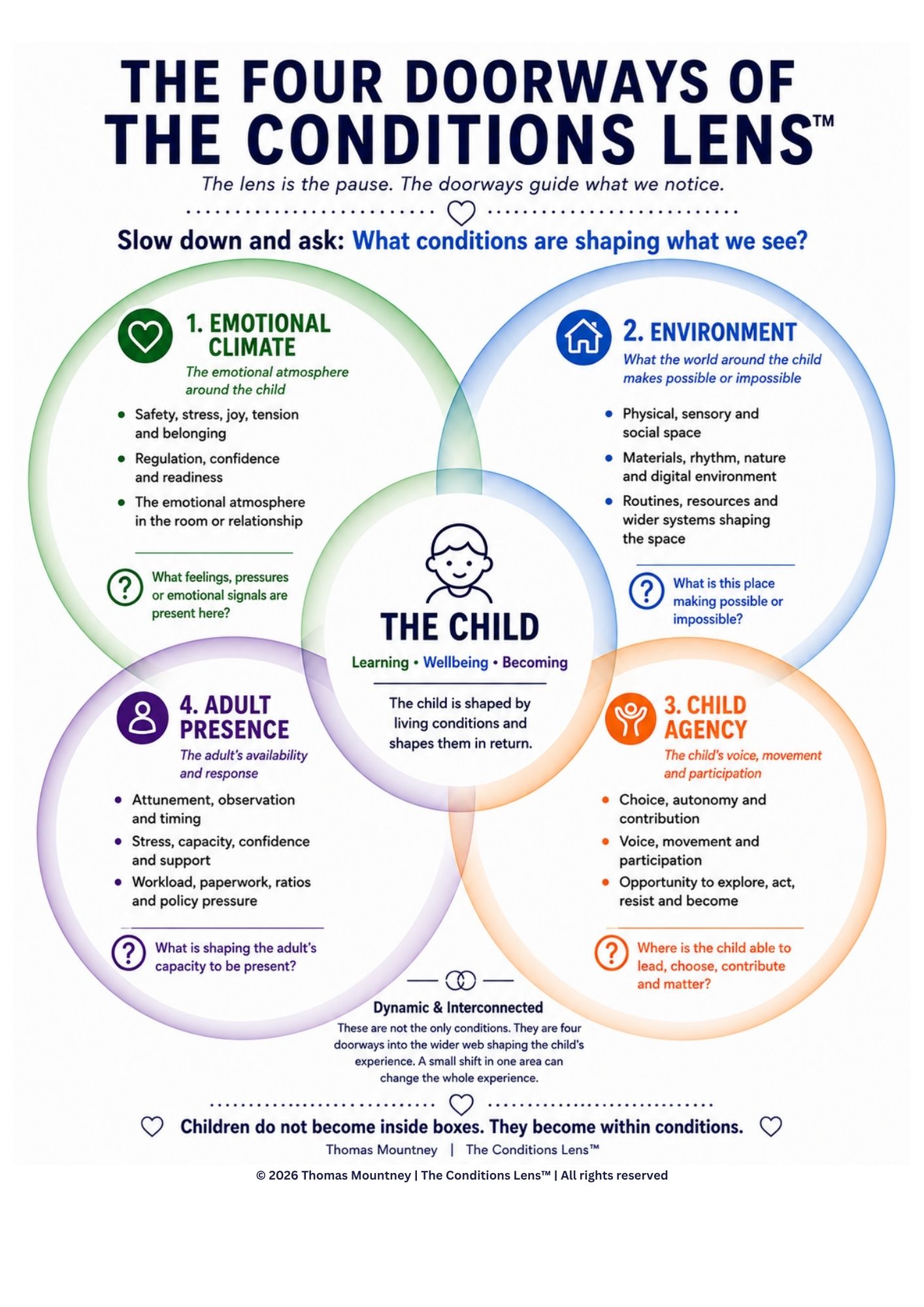
How to use The Four Doorways of the Conditions Lens™
The Four Doorways are a simple way to pause and ask:
What conditions are shaping what we see?
They are not another set of boxes to place children inside. They are four ways of opening what we notice:
Emotional Climate – what emotional atmosphere is present?
Environment – what is the world around the child making possible or impossible?
Child Agency – where is the child able to lead, choose, contribute and matter?
Adult Presence – what is shaping the adult’s capacity to be present?
The child is not passive inside these conditions. The child is shaped by living conditions and also shapes them in return.
For a fuller explanation, you can download the Four Doorways PDF from the resources above.
How to Use The Conditions Check-In
The Conditions Check-In is designed to be used by you.
You can read it, print it, write into it, talk through it with another person, or use it quietly on your own to reflect on a situation.
The purpose is not to find a perfect answer.
The purpose is to pause, slow down and ask:
What conditions are shaping what is happening here?
The Check-In helps you begin with what is actually known, distinguish observation from interpretation, keep uncertainty open, widen attention to relevant conditions, look backward at what may have preceded or accumulated before the visible moment, and consider what conditions might reasonably be changed.
It is not designed to diagnose people, excuse harmful behaviour, avoid accountability or minimise the impact of someone’s actions.
Understanding conditions should deepen responsibility, not reduce it. Responsibility should follow condition-shaping power where possible. If harm has occurred, it must still be named, addressed and responded to through appropriate safeguarding, professional or organisational procedures.
Using the Check-In with AI
The Conditions Check-In can also be used alongside AI tools such as ChatGPT, Copilot or Gemini.
If you choose to use AI, give it the full Conditions Check-In and ask it to work through the steps in sequence.
The Check-In includes specific safeguards for AI use because AI can fill gaps, infer motives or feelings, introduce familiar explanations, mistake a possible condition for a known cause, or suggest interventions that are not actually supported by the information provided.
Used properly, AI can help organise reflection, identify missing information and widen attention.
It should not make the judgement for you.
Keep examples anonymous. Avoid entering names, identifying details or sensitive personal information about children, families, colleagues or services.
AI should never replace your own judgement, professional responsibility, safeguarding duties, supervision or human support.
The aim of The Conditions Check-In is to strengthen your own ability to pause, notice, reflect and respond. It is not to send every difficult moment to AI.
Return to Real Life
If you use AI to help you reflect, do not end the process at the screen. Once the reflection is complete, step back into real life and ask:
What condition, if any, can I now change, soften, protect or create?
Then notice what happens.
What shifted?
What became easier or harder?
What stayed the same?
What became newly visible?
The purpose of reflection is not to stay in thought. It is to return with greater care to the child, adult, room, relationship, routine, policy, place or moment in front of you.
AI may help you pause and organise your thinking. The work of tending to conditions remains yours.
How to use When Digital Access Changes
When Digital Access Changes is designed to be used by parents, carers and families as a gentle reflection tool.
You can read it, print it, write into it, talk through it with another trusted adult, or use it quietly on your own to reflect on what may be happening for a child or teenager when digital access is reduced, restricted or removed.
The purpose is not to find a perfect answer.
The purpose is to pause, slow down, and ask:
What conditions are shaping what is happening here?
This resource is not designed to excuse harmful behaviour, remove boundaries, avoid accountability, or ignore risk. Understanding what digital access may have been providing should deepen adult responsibility, not reduce it.
If a child or teenager is in distress, struggling with their mental health, showing signs of self-harm, suicidal thoughts, extreme withdrawal, panic, aggression, trauma responses, eating difficulties, sleep collapse, or any behaviour that causes serious concern, this resource should not be used as a substitute for professional help.
In those situations, parents and carers should seek appropriate support from a GP, mental health professional, emergency service, school support team, crisis service, or relevant safeguarding service.
This resource can also be used alongside AI tools such as ChatGPT, Copilot or Gemini, but only as an occasional aid to reflection. AI may help you move through the questions, organise your thoughts, or notice possible patterns. It should not become something you rely on every time a difficult moment happens.
Please keep examples anonymous. Avoid entering names, identifying details, or sensitive personal information about children, teenagers, families, schools, services or other people.
AI should never replace your own judgement, parental responsibility, professional advice, safeguarding duties, crisis support, supervision or human care.
If you choose to use AI to help you reflect, try not to end the process at the screen.
Once the reflection is complete, step back into real life and ask:
What condition can I now tend to, soften, protect or create?
The purpose of reflection is not to stay in thought.
It is to return with greater care to the child, teenager, relationship, room, routine, friendship, home, community or moment in front of you.
AI may help you pause and organise your thinking, but the work of tending to conditions remains human.
Use of these resources is guided by the Authorship and Use of Terms page.