Reclaiming the Ecosystem of Childhood
A Conditions Lens™ Inquiry into Childhood in the Digital Age
This is the central website version of this Conditions Lens™ piece.
Written by: Thomas Mountney, MA Early Childhood Studies
Role: Early Childhood Specialist
Part of: The Conditions Lens™ body of work
First published: 18 May 2026
Reading time: Approximately 40 minutes
Reading support
This is a long-form reflective piece. For readers who use AI tools for reading support, audio support, summary or reflection, an optional copy-and-paste prompt is included at the bottom of the page.
The prompt is designed to help the article be read carefully as part of the wider Conditions Lens™ body of work, without losing its emotional, ethical or ecological depth.
The prompt is provided to support careful reading, reflection and accessibility. It does not grant permission to reproduce, adapt or republish the article without attribution or consent.
Summary
This piece introduces the Conditions Lens™ through an inquiry into the conditions surrounding childhood in the digital age. It asks how digital environments interact with relational, emotional, material and environmental conditions around children, and how these conditions may shape attention, behaviour, agency, adult presence, participation and connection with the living world over time.
Rather than treating digital technology as a single cause, the piece widens attention to the broader ecology in which children, adults, technologies, relationships and environments interact.
Author note
Developed through practice-informed observation and reflection in early childhood, alongside engagement with literature and ideas concerning development, attachment, ecology, environmental conditions and digital environments.
Copyright
© Thomas Mountney, 2026. This piece forms part of The Conditions Lens™, a developing body of work and framework by Thomas Mountney. All rights reserved.
Full Article
Table Of Contents
- Introduction: Childhood as an Ecosystem
- Attention as a Developmental Resource
- Foundational Human Variation
- Temperament and Individual Variation
4.1 Understanding Temperament
4.2 Sensitive or Cautious Children
4.3 High-Energy or Highly Active Children
4.4 Socially Oriented or Approval-Sensitive Children - The Four Doorways of the Conditions Lens™
5.1 Doorway 1: Emotional Climate
5.1.1 The Loss of Boredom
5.1.2 Digital Conditions
5.2 Doorway 2: Adult Presence
5.2.1 Adults as Environmental Architects
5.2.2 Digital Conditions
5.3 Doorway 3: Child Agency
5.3.1 Embodied Development
5.3.2 Digital Conditions
5.4 Doorway 4: Environment
5.4.1 Pace and Environmental Rhythm
5.4.2 Digital Conditions
5.4.3 Ecological Separation - The Digital Ecosystem Audit
- Theoretical Foundations
- Closing Reflection
- Author Reflection
- References
Introduction: Childhood as an Ecosystem
Humans do not merely exist within environments. They develop through ongoing interaction with the conditions surrounding them.
Childhood is now taking place within a rapidly changing environmental landscape. Children develop not only within families, communities, schools and physical environments, but also alongside digital platforms, algorithmic systems and increasingly continuous streams of mediated information and stimulation.
Digital technologies have transformed communication, access to information, creativity and everyday life. They have also introduced conditions that differ in important ways from many of the environments in which childhood has historically unfolded.
The purpose of this inquiry is not to position technology as inherently good or bad. Instead, it asks:
What conditions are digital environments creating, and what patterns may emerge through repeated exposure to those conditions over time?
Human development is ecological in the sense that children do not develop in isolation. Development takes place within relationships, environments and wider social systems (Bronfenbrenner, 1979; Shonkoff and Phillips, 2000).
Changes in those conditions can therefore alter what becomes easier, harder, more likely or less available within development.
The Conditions Lens emerged through observation and reflection across childhood, attachment, behaviour, environment, ecology and human development.
Traditionally, ecosystems describe networks of organisms interacting with one another and with their environments.
Within the Conditions Lens, ecosystem is used more broadly as a way of thinking about interacting conditions that repeatedly shape what becomes possible over time.
Families can be understood in this way.
Schools can be understood in this way.
Communities can be understood in this way.
Digital environments can also be examined in this way, as networks of interacting conditions rather than as isolated tools.
The digital environment may include conditions such as:
- algorithmic curation,
- attention capture,
- notifications,
- rapid shifts in stimulation,
- social feedback loops,
- reward-driven design,
- mediated relationships,
- and continuous information exposure.
These conditions do not affect every child in the same way.
Their influence will depend on factors such as age, temperament, developmental stage, relationships, context, duration, content, adult involvement and the wider conditions surrounding digital use.
The Conditions Lens does not treat digital environments as a single cause.
It asks how repeated digital, relational, sensory, emotional and environmental conditions may interact over time, and what patterns become visible through those interactions.
Rather than viewing development through isolated behaviours or traits, it asks:
What conditions are repeatedly shaping the child, and what patterns may be emerging over time?
Digital spaces are no longer simply tools used occasionally. For many children, they form part of the environments within which everyday life now unfolds.
This matters because repeated environments can influence patterns of attention, expectation, interaction and behaviour.
Highly stimulating digital experiences may, for some children and in some contexts, make slower transitions, waiting, boredom or disengagement from stimulation more difficult.
That does not mean digital technology necessarily causes difficulty.
Nor does it mean that every child will respond in the same way.
It means that the conditions surrounding digital use deserve examination.
When a child becomes distressed after a device is removed, the visible behaviour should not automatically be treated as evidence of defiance, poor regulation or technological harm.
Instead, the Lens asks:
What happened before the distress?
How long had the child been engaged?
What was the pace and intensity of the experience?
What transition was being asked of them?
What other emotional, relational or sensory conditions were present?
What patterns have been observed over time?
One possible explanation may involve difficulty shifting away from a highly engaging condition.
Other explanations may also be present.
The task is not to assume the cause, but to widen the inquiry.
The same caution applies when thinking about nervous-system adaptation.
Human bodies continually respond to repeated experience and environmental input. However, the Conditions Lens does not require us to claim one simple neurological pathway from digital stimulation to later behaviour.
It asks instead whether repeated conditions of speed, novelty, interruption and continuous engagement may interact with development in ways that become visible through attention, regulation, relationships or everyday transitions.
These questions are increasingly relevant as digital environments become more embedded within childhood.
The moth drawn toward artificial light can offer a useful metaphor.
The moth is not weak because its behaviour changes around a powerful environmental stimulus. Its response emerges within an interaction between organism and condition.
Human development is far more complex, but the comparison reminds us not to locate every difficulty solely inside the individual.
The Conditions Lens therefore asks how digital environments may become part of a wider developmental ecology shaping:
- attention,
- emotional experience,
- behaviour,
- identity,
- relationships,
- sensory experience,
- agency,
- and the pace of everyday life.
The question is not whether children should or should not encounter technology.
The question is:
What conditions surround digital use, and do those conditions support the child who is living within them?
This inquiry does not argue for the removal of digital technology from childhood.
It argues for closer attention to the conditions digital environments may create, the experiences they may displace or compete with, and the ways adults can protect space for relationship, movement, rest, boredom, exploration, embodiment and connection with the living world.
Attention as a Developmental Resource
Within the digital ecosystem, attention has become one of the most competed-for developmental resources.
What repeatedly captures attention can influence what becomes familiar, significant, expected and repeatedly practised over time.
Like all ecosystems, digital environments contain competing forces that attract, hold and redirect attention. Algorithms, notifications, short-form content, autoplay systems, reward loops and personalised feeds are often designed to increase engagement and prolong interaction.
The issue is not simply that children use technology.
The issue is that many digital environments are deliberately structured around attention capture.
Within the Conditions Lens, attention is therefore treated as an important condition within development. What children repeatedly attend to may influence patterns of expectation, behaviour, emotional significance and engagement over time.
Repeated exposure to environments characterised by:
- rapid novelty,
- immediate reward,
- continuous stimulation,
- frequent interruption,
- and fragmented focus
may, for some children and in some contexts, make slower forms of engagement more difficult.
This may become visible through difficulty with:
- sustained concentration,
- patience,
- transitions,
- boredom,
- reflective thinking,
- or activities that do not offer immediate stimulation.
The Conditions Lens does not frame children as weak or deficient for responding to these environments.
Organisms respond to the conditions that repeatedly surround them.
The question is therefore not simply whether a child can “pay attention,” but what kinds of environments are repeatedly competing for that attention, what patterns those environments may be encouraging, and what other forms of experience may be receiving less time or space.
Historically, many childhood environments contained greater opportunities for:
- stillness,
- observation,
- imagination,
- uninterrupted play,
- physical exploration,
- and slower engagement with the material world.
Digital environments can offer creativity, connection, information and play, but many are also structured around interruption, acceleration and continuous engagement.
The Conditions Lens therefore asks:
What happens when attention itself becomes one of the most heavily competed-for resources within the child’s environment?
Foundational Human Variation
Within the Conditions Lens, biological and neurodevelopmental variation is understood as part of what each human being brings into interaction with the conditions surrounding them.
Human beings do not enter the world as identical bodies, nervous systems or sensory systems.
Each child brings their own:
- biology,
- sensory processing,
- neurological variation,
- developmental differences,
- temperament,
- genetic predispositions,
- and individual ways of experiencing and responding to the world.
These differences form part of the natural variation present across human development.
In ecological systems:
- organisms vary,
- environments vary,
- and what emerges depends partly on their interaction.
There is no single “correct” organism against which every response should be measured.
The Conditions Lens therefore does not assume that the same environment will affect every child in the same way.
Instead, what becomes possible is understood as emerging through ongoing interaction between:
- the individual child,
- their biological, neurological and sensory variation,
- and the conditions surrounding them in the moment and over time.
For some children, certain environments may feel:
- regulating,
- restorative,
- supportive,
- or engaging.
For others, similar environments may feel:
- overwhelming,
- fragmented,
- demanding,
- or emotionally exhausting.
This is particularly important when considering neurodevelopmental and sensory variation.
A fast-paced, noisy or highly stimulating environment may interact very differently with different children, just as quieter, slower or more sensory-rich environments may support different children in different ways.
The Conditions Lens therefore recognises that human flourishing cannot be understood apart from the interaction between:
- individual variation,
- sensory experience,
- developmental needs,
- relationships,
- and the environments people repeatedly inhabit.
Temperament and Individual Variation
Not all children experience digital conditions in the same way. Temperament is one part of that variation.
All children have temperament. What differs is how strongly particular tendencies, sensitivities, activity levels, preferences or patterns of response are expressed, and how these interact with the conditions surrounding the child.
Within the Conditions Lens, temperament is understood as one aspect of broader human variation (Thomas and Chess, 1977). It refers to relatively enduring patterns in how children tend to approach, experience and respond to the world around them.
Children are not blank slates. From early life, they may differ in patterns of:
- sensitivity,
- intensity,
- activity,
- adaptability,
- attention,
- caution,
- sociability,
- and responsiveness to stimulation.
Temperament is not fixed destiny. How these tendencies become visible can change through development and through ongoing interaction with relationships, environments, expectations and experience.
Temperament is not good or bad.
A child who is cautious, highly sensitive, very active or strongly socially oriented is not therefore a “difficult” child. The question is how that child’s individual variation interacts with the conditions surrounding them.
The Conditions Lens therefore asks not only:
What conditions are present?
but also:
How might this child be experiencing those conditions?
The same digital environment may be experienced differently by different children.
A fast-paced or highly stimulating digital environment may feel overwhelming to one child while another appears less affected. A child who is more sensitive to sound, movement, pace or emotional tone may find loud, rapid or unpredictable digital conditions more demanding.
This does not mean the child is the problem.
It means that understanding the interaction between the child and the surrounding conditions matters.
The following examples are not fixed labels, diagnoses or permanent categories. They illustrate ways different temperamental tendencies may interact with digital conditions. Children may show several of these patterns, or experience them differently depending on age, development, context, stress, safety, tiredness and relationships.
Sensitive or Cautious Children
Children who are more sensitive to sensory or emotional input may find highly stimulating digital environments more demanding.
Depending on the child and context, this may become visible through:
- overwhelm,
- anxiety,
- withdrawal,
- irritability,
- or difficulty shifting away from stimulation.
High-Energy or Highly Active Children
Children with strong movement needs or a preference for active exploration may experience prolonged sedentary digital engagement differently from children who are more comfortable with stillness.
For some children, reduced opportunities for movement or physical agency may contribute to:
- frustration,
- restlessness,
- difficulty sustaining slower activities,
- or difficulty transitioning between forms of engagement.
The relevant question is not whether high activity is a problem, but whether the surrounding conditions provide enough space for movement, agency and varied forms of engagement.
Socially Oriented or Approval-Sensitive Children
Children who are strongly attuned to relationships, belonging and social feedback may experience digitally mediated social environments differently from children who are less influenced by external evaluation.
Repeated exposure to:
- likes,
- metrics,
- online approval,
- peer comparison,
- and continuous social visibility
may, for some children, intensify concern about belonging, exclusion, identity or how they are perceived by others.
The Conditions Lens therefore asks how digital environments organised around social evaluation interact with the individual child, rather than assuming that the same conditions will affect everyone in the same way.
The Four Doorways of the Conditions Lens™
The Four Doorways are not isolated categories, and they are not the only conditions shaping childhood. They are practical ways into the wider web of conditions surrounding the child.
The pause is one way into the Lens. It creates space to slow down before rushing to blame, label, correct, measure or prove. The Doorways then help guide what we notice.
Within digital childhood, they offer a way of asking how digital conditions may interact with emotional climate, adult presence, child agency and environment.
The child is not passive within these conditions. Children are shaped by the conditions surrounding them, but they also shape those conditions in return.
The Doorways do not tell us in advance what technology is doing to a child. They help us notice what may be worth examining.
| Doorway | Conditions that may support | Digital conditions to notice |
|---|---|---|
| Emotional Climate | Time, recovery, movement, emotional safety, reflection | High stimulation, emotional arousal, frequent interruption, difficulty disengaging |
| Adult Presence | Attunement, responsiveness, co-regulation, shared attention | Divided attention, interruptions, adult digital overload, technoference |
| Child Agency | Physical exploration, meaningful choice, embodied competence, contribution | Highly directed interaction, reduced physical movement, constrained choice, limited embodied problem-solving |
| Environment | Sensory richness, slower rhythms, three-dimensional space, material and outdoor experience | Prolonged sedentary engagement, rapid sensory change, screen-mediated experience, displacement of physical exploration |
The question is not whether digital environments are inherently harmful or beneficial. The question is what conditions they create, what they may displace, and how those conditions interact with the child over time.
Doorway 1: Emotional Climate
Children move through changing emotional states throughout everyday life. Their ability to remain engaged, recover from frustration, tolerate uncertainty and return to activity is shaped by relationships, safety, time, movement, adult support and the wider conditions surrounding them.
Emotional experience does not happen separately from the body, but the Conditions Lens does not require us to reduce emotion to physiology. Instead, it asks what conditions may be helping a child move through an emotional state, and what conditions may be making that movement harder.
The Loss of Boredom
Within many modern digital environments, boredom can be interrupted almost immediately.
Waiting, stillness, frustration or the simple absence of something exciting can now be met with instant access to entertainment, novelty and distraction.
This matters because boredom is not necessarily an empty space.
It can be a transition space.
A child who initially says, “I’m bored” may, given time, begin looking around, moving, imagining, making, experimenting, talking or creating something that was not externally provided.
In that sense, boredom can act like a bridge.
On one side is the absence of immediate stimulation.
On the other may be imagination, movement, exploration, creativity, relationship or self-directed activity.
Not every period of boredom will lead somewhere meaningful, and children do not need to be left unsupported through distress. But if every moment of low stimulation is immediately filled, children may have fewer opportunities to discover what can emerge from those moments themselves.
Digital environments characterised by continuous novelty and easily available stimulation may sometimes shorten that bridge.
Rather than remaining within a slower moment long enough for another activity or interest to emerge, the child can move immediately back toward externally provided stimulation.
Over time, this raises an important Conditions Lens question:
What happens when fewer spaces in childhood are left unfilled?
The concern is not that children enjoy technology or seek stimulation.
The concern is whether childhood still contains enough room for:
- waiting and slowing down,
- imaginative wandering,
- physical exploration,
- self-directed activity,
- emotional recovery,
- and engagement with the people and material world nearby.
Within the Conditions Lens, boredom is therefore not automatically treated as a problem to remove.
Sometimes it may be open ground from which something else can begin.
Digital Conditions
Many digital environments are designed to encourage continued engagement, including through features such as notifications, autoplay, rapidly changing content and personalised recommendations.
For some children, repeated engagement with highly stimulating digital experiences may make the transition toward slower or less immediately rewarding activities more difficult.
This might become visible through irritability when stopping, repeated requests to continue, difficulty shifting attention, or frustration with activities that offer less immediate stimulation.
These responses should not automatically be interpreted as evidence that technology has harmed the child.
Nor should they simply be labelled as poor behaviour.
The Lens asks instead:
What conditions surrounded the response?
How long had the child been engaged?
What was the pace and intensity of the experience?
Was the transition expected or sudden?
What was the child being asked to move toward?
What other emotional, relational or environmental conditions were present?
And what pattern, if any, has become visible over time?
The issue is not the existence of technology itself.
It is whether digital stimulation has become one condition among many in childhood, or whether it is beginning to displace the quieter conditions through which children also explore, imagine, recover, relate and become. issue is whether the emotional conditions surrounding digital use allow the nervous system opportunities for recovery, reflection, and regulation.
Doorway 2: Adult Presence
Relational Conditions
Children develop capacities for emotional regulation within relationships. Responsive and emotionally available adult relationships can support safety, confidence, regulation and social development (Bowlby, 1969; Siegel, 2012).
Children are sensitive to relational cues such as adult:
- tone of voice,
- facial expression,
- responsiveness,
- proximity,
- availability,
- and consistency over time.
The Conditions Lens therefore treats Adult Presence as more than whether an adult is physically nearby.
It asks how the adult is able to be present within the conditions surrounding the interaction.
Adults as Environmental Architects
Children do not independently construct the conditions surrounding childhood.
Adults are among the most influential architects of those conditions.
Through everyday decisions and routines, adults help shape:
- emotional climate,
- technological boundaries,
- sensory environments,
- pace and timing,
- opportunities for movement and outdoor exploration,
- relational availability,
- expectations,
- and patterns of interaction.
The metaphor of the adult as an architect does not mean adults control every part of childhood.
Architects also work within constraints.
Parents, caregivers and practitioners themselves live within conditions shaped by work, exhaustion, finances, policy, housing, technology, social expectations and limited time.
Many adults are also navigating digital environments characterised by notifications, information overload, divided attention and expectations of constant availability.
The Conditions Lens therefore does not ask simply:
Why is this adult distracted?
It asks:
What conditions are shaping the adult presence available to the child?
Digital technologies can become part of those conditions.
Repeated interruption may fragment moments of conversation, shared attention or relational availability. An adult may be physically present while their attention moves repeatedly between the child, a message, work, news, social media or another digital demand.
This does not mean the adult is uncaring.
Nor does it mean every interruption is developmentally harmful.
It means that presence itself has conditions.
The child also shapes what happens next. A child may call, touch, interrupt, withdraw, increase the intensity of their behaviour or seek another way of regaining interaction. The adult then responds within their own emotional, attentional and environmental conditions.
What emerges is relational and reciprocal.
The concern is therefore not simply how much technology adults use, but what patterns of presence are becoming ordinary within family life.
The Conditions Lens asks:
What happens when divided attention becomes a repeated condition within the child’s relational environment?
Supporting childhood in a digital age therefore involves more than managing the child’s access to technology.
It also means examining the conditions surrounding the adults who shape childhood, including whether those adults have enough time, support, attention and relational space to be present in the ways they would like to be.
Digital Conditions
Research on technoference has examined how device-related interruptions can enter parent-child interactions and affect patterns of responsiveness and interaction (McDaniel and Radesky, 2018).
The Conditions Lens does not interpret this as evidence that devices destroy attachment or that every interruption causes harm.
Instead, it asks what happens when interruption becomes repeated, how the child responds, how the adult responds in return, and what pattern develops over time.
A useful question is therefore:
What conditions are supporting or fragmenting adult presence here?
Doorway 3: Child Agency
Agency and Embodied Participation
Children develop knowledge and competence through active participation in the world around them. Developmental and sociocultural perspectives have long emphasised the importance of activity, interaction and participation within learning and development (Piaget, 1952; Vygotsky, 1978).
Within the Conditions Lens, agency concerns the extent to which children can influence what happens around them.
Can they choose?
Can they initiate?
Can they refuse?
Can they alter the environment?
Can they test an idea?
Can they contribute to something that matters beyond the activity itself?
Agency is therefore more than being offered a choice between options already decided by an adult or designed into a system.
Embodied Development
Children do not learn only through watching, listening or receiving information.
They also learn through doing.
Movement, touch, balance, texture, resistance, temperature, sound, space and physical consequence all form part of children’s encounters with the world.
When children:
- climb,
- dig,
- build,
- carry,
- balance,
- manipulate tools,
- care for plants,
- move objects,
- test possibilities,
- and navigate changing environments,
they are not simply “burning energy.”
They are acting upon the world and receiving something back from it.
A branch bends.
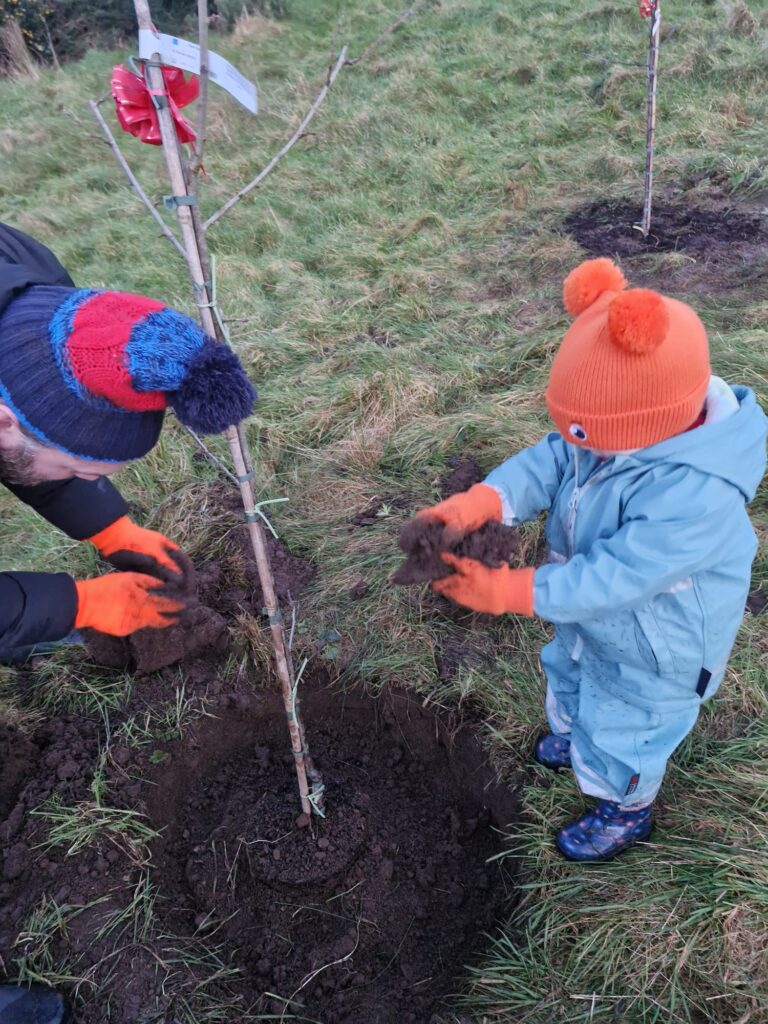
Mud gives way.
A stone is heavier than expected.
Water spills.
A structure falls.
A tool extends what the hand can do.
The material world answers back.
That feedback is not pre-scripted. It emerges through the interaction between the child, the material, the environment and what the child is trying to do.
Through these experiences, children may develop coordination, practical judgement, spatial understanding, confidence, problem-solving and familiarity with their own capacities and limits.
This is one reason embodied experience matters within the Conditions Lens.
It allows children not only to encounter an environment, but to participate in shaping it.
Digital environments can also support creativity, communication, problem-solving and agency.
However, digital agency often occurs within systems whose possible actions, rewards, boundaries and responses have already been designed by someone else.
A child may choose where to move a character, what to build in a game or which video to watch, but the field of possibility is still structured by the architecture of the platform.
That does not make digital agency meaningless.
It raises a different question:
What kinds of agency are being practised here, and what kinds are receiving less opportunity elsewhere?
The concern is therefore not that digital experiences are representations while physical experiences are somehow the only “real” learning.
The concern is displacement.
If increasing amounts of childhood are spent within highly structured digital environments, children may have fewer opportunities to encounter forms of agency involving:
- unpredictable material consequences,
- physical effort,
- movement through space,
- practical problem-solving,
- contribution to shared activity,
- encounters with manageable risk,
- and changing the physical environment around them.
The Conditions Lens therefore asks not simply whether a child is interacting.
It asks:
What can the child actually influence here?
Digital Conditions
Digital environments can provide meaningful forms of choice, creativity and participation.
They can also constrain agency when interaction is largely limited to pathways, responses and rewards predetermined by the system.
The question is not whether digital interaction has value.
It is whether children also have enough opportunities to exercise agency in environments where the outcome is not already coded, where materials resist, other people respond unpredictably, and the child’s actions can make a tangible difference to what happens next.
The question is whether it is replacing experiences necessary for the development of physical confidence and real-world agency.
Doorway 4: Environment
Environmental Conditions
Children experience development through physical, sensory, relational and material environments.
Those environments differ in pace, intensity, predictability, movement, texture, sound, light, space and opportunities for interaction.
Outdoor and natural environments can offer:
- changing light and weather,
- varied textures and surfaces,
- movement through three-dimensional space,
- unpredictable material encounters,
- sensory diversity,
- and opportunities for exploration, observation and recovery.
These conditions are not automatically beneficial for every child in every moment, but they can provide forms of experience that differ substantially from those found in many digital environments.
Pace and Environmental Rhythm
Pace is itself a condition worth noticing.
Some environments unfold slowly.
Light changes across the day.
Weather shifts.
A walk takes time.
A structure must be built piece by piece.
Mud must be dug.
A plant grows at its own pace.
Other environments can change almost instantly.
A swipe produces new content.
A notification interrupts.
A video begins automatically.
A feed refreshes.
A reward appears immediately.
Neither speed nor slowness is inherently good or bad.
The Conditions Lens asks what happens when one pace becomes dominant.
Repeated exposure to fast, highly stimulating environments may, for some children, make slower transitions or less immediately rewarding activities more difficult.
This may become visible through:
- restlessness,
- impatience,
- difficulty shifting attention,
- frustration during slower activities,
- repeated seeking of stimulation,
- or difficulty remaining with tasks that unfold gradually.
These responses should not automatically be attributed to digital use.
They may also reflect tiredness, temperament, relationships, expectations, sensory needs, stress or other surrounding conditions.
The question is not:
Is fast stimulation bad?
It is:
What rhythms of experience are surrounding this child, and what kinds of engagement are those rhythms making easier or harder?
A useful metaphor is a landscape.
Different terrains invite different ways of moving.
A steep slope, open field, narrow path and paved road do not force one response, but each makes some movements easier and others harder.
Digital environments can be thought about similarly.
Their pace, architecture and sensory design create particular pathways of attention and interaction.
The task is to notice what those pathways invite, what they constrain, and what may be receiving less space elsewhere.
Digital Conditions
Many screen-based environments can be fast-paced, visually dense, highly responsive and relatively sedentary.
When they occupy large parts of daily life, they may compete with time otherwise available for:
- movement,
- outdoor exploration,
- sensory variety,
- physical experimentation,
- unstructured play,
- and contact with the living world.
The concern is therefore not that digital environments are unnatural and physical environments are automatically healthy.
It is that different environments offer different conditions.
The Conditions Lens asks:
What is this environment repeatedly asking the child’s attention, body and relationships to do?
And:
What other kinds of experience may be becoming less available as a result?
Ecological Separation
The Conditions Lens begins from an ecological view of the human being.
Humans are not separate from the living world and then occasionally connected back to it. We are ecological beings, shaped through ongoing relationship with land, weather, other species, materials, food, water, seasons and the wider systems that sustain life.
Ecological connection is therefore not simply an added benefit of childhood. It is part of the conditions within which human life has always become.
Weather, soil, plants, insects, animals, changing light, seasonal change and direct sensory encounters with outdoor environments have formed part of the conditions within which generations of children have lived, moved, explored and learned.
These environments are more than scenery.
They offer opportunities for children to encounter living systems directly through movement, observation, participation, uncertainty and sensory experience.
Within the Conditions Lens, ecological connection means more than simply spending time outdoors.
It involves developing familiarity and relationship with the living world through repeated encounters with it.
A child may notice where insects gather.
They may learn which ground holds water.
They may recognise a bird call.
They may discover that some plants bend, some sting, some feed and some shelter.
They may watch something grow, decay, return or disappear with the season.
Through repetition, the environment stops being only a background.
It becomes a place the child knows through participation.
This is where the idea of ecological separation enters the Conditions Lens.
Ecological separation is not simply distance from outdoor space.
It describes a possible weakening of lived relationship with the systems of life of which the child is already part.
It does not mean that a child who uses digital technology is disconnected from nature.
Nor does it mean that time outdoors automatically produces ecological care or wellbeing.
It asks whether changing conditions of childhood are reducing opportunities for children to build sustained, embodied familiarity with the living world.
When digitally mediated experience occupies increasing amounts of time and attention, children may have fewer opportunities to:
- notice seasonal change,
- encounter biodiversity,
- explore changing physical environments,
- develop familiarity with local places,
- and participate directly in living systems.
A child can know many facts about nature while having relatively little lived relationship with it.
They may be able to identify an animal on a screen without ever having waited quietly enough to notice one nearby.
They may understand the idea of soil without knowing its weight, smell, resistance or the life within it.
This is not a criticism of digital learning.
It is a distinction between knowing about a living system and knowing it through repeated relationship.
The Conditions Lens therefore asks:
What changes when more of the world is encountered through representation and less through direct participation?
Natural and outdoor environments also differ from many digital environments in important ways.
They are not fully scripted.
A path changes after rain.
A plant grows without waiting for the child.
An insect leaves.
Wind alters what can be heard.
Mud resists.
Weather interrupts plans.
The child enters an environment that already has its own processes, rhythms and forms of life.
The world does not simply respond because the child clicked, swiped or selected something.
The living world has its own agency.
An ecological view resists placing the child outside that world as a detached observer.
The child is already within it, affecting and being affected by the living systems around them.
That matters because it places the child within a wider web of life rather than always at the centre of the interaction.
Direct ecological experience may offer opportunities for observation, movement, curiosity, imagination, practical competence, sensory familiarity and the development of relationship with place.
The concern is therefore not simply reduced outdoor time.
It is whether children are receiving enough opportunity to experience themselves as participants within a living world rather than only observers or consumers of representations of it.
Within the Conditions Lens, ecological separation is therefore a question of relationship:
What conditions allow children to know that they belong to a living world because they have actually participated within it?
The Digital Ecosystem Audit
The Digital Ecosystem Audit is not a diagnostic or scoring tool.
It is a set of reflective questions for noticing patterns around digital use and considering what other conditions may be present.
A single difficult transition or period of heavy digital use does not establish a pattern. The aim is to notice what happens across time and context.
1. Emotional Climate
The Rest Test
Does the child regularly experience unstructured time without immediate digital stimulation, with room for boredom, imagination, self-directed activity or emotional recovery?
The Transition Check
After digital use, what tends to happen?
Does the child move relatively easily into what comes next, or do you repeatedly notice:
- irritability,
- frustration,
- difficulty disengaging,
- repeated requests to continue,
- or difficulty settling into slower activities?
The question is not whether one response is “good” or “bad,” but whether a pattern is becoming visible.
2. Adult Presence
The Presence Check
When adults and children are together, what conditions support shared attention, responsiveness and connection?
The Attention Check
How often are interactions interrupted by:
- notifications,
- device checking,
- work demands,
- divided attention,
- or other digital interruptions?
And importantly:
What conditions are shaping the adult’s availability too?
3. Child Agency
The Participation Check
Does the child regularly have opportunities to act upon the physical world through activities such as:
- making,
- building,
- drawing,
- digging,
- carrying,
- caring for plants or animals,
- using tools,
- or changing the environment around them?
The Challenge and Problem-Solving Check
Does the child have opportunities for age-appropriate:
- physical challenge,
- exploration,
- practical problem-solving,
- manageable risk,
- and increasing independence?
The question is not simply whether the child is “active,” but:
What can the child actually influence, change, create or contribute to?
4. Environment
The Movement Check
Does everyday life include opportunities for the child to move dynamically through space rather than spending long periods predominantly sedentary?
The Living World Check
Are outdoor and living environments part of the child’s regular experience?
Does the child have opportunities to notice, explore and develop familiarity with:
- weather,
- plants,
- soil,
- animals,
- seasonal change,
- and local places?
The aim is not to create a perfect balance.
It is to notice what conditions are becoming dominant, what may be receiving less space, and what might reasonably be protected, changed or created.
Theoretical Foundations
The Conditions Lens™ does not seek to replace established developmental or ecological theories, nor are the Four Doorways derived from one single theoretical tradition.
This piece sits alongside and is informed by bodies of knowledge including:
- Attachment Theory, particularly the work of John Bowlby
- Bronfenbrenner’s ecological and bioecological approaches to human development
- constructivist and sociocultural perspectives associated with Jean Piaget and Lev Vygotsky
- literature concerning sensory experience, embodied learning and development
- contemporary research examining digital media, attention, parent-child interaction and technoference
These bodies of knowledge illuminate different dimensions of childhood and development.
The Conditions Lens™ provides a separate interpretive orientation through which attention can be returned to the conditions surrounding what becomes visible.
It does not claim that technology alone determines developmental outcomes.
Instead, it asks how digital conditions may interact with individual variation, temperament, relationships, sensory experience, material environments, social context and the wider conditions of childhood over time.
Closing Reflection
This is not an argument against modern life.
It is an invitation to become more attentive to the conditions within which childhood is taking place.
Technology will remain part of human life. The question is not whether children should live entirely inside or outside digital environments.
The question is what conditions those environments create, what they make possible, what they may constrain or displace, and how they interact with the individual child and the wider ecology of childhood.
Digital environments can support creativity, communication, learning, play and connection.
Children also need conditions that leave room for:
- attention,
- relationship,
- movement,
- embodied participation,
- agency,
- rest,
- ecological connection,
- and engagement with the material and living world.
Children do not simply use environments.
They are shaped by them, and they also shape them in return.
The Conditions Lens™ therefore asks not only what technology can do, but:
What conditions are we creating around childhood, and what are those conditions helping to make possible next?
Author Reflection
The Conditions Lens™ did not emerge solely through academic study.
It developed through years of observing children, families, behaviour, relationships and environments through professional practice and lived experience.
Alongside work in early childhood, the framework has also been shaped by practical engagement with land, biodiversity, outdoor environments and repeated observation of how living systems respond to changing conditions over time.
These experiences reinforced a recurring observation:
Living beings are not separate from the conditions surrounding them. What becomes possible emerges through ongoing interaction between the living being and the conditions within which it exists.
They also highlighted how differently individuals may experience and respond to apparently similar environments.
The Conditions Lens™ emerged from this movement between practice, observation, ecological attention and engagement with existing scholarship.
It is presented as a distinct interpretive framework while remaining in conversation with developmental, ecological, attachment, sensory and sociocultural perspectives.
Its central question remains simple:
What conditions are shaping what we see?
Reference List
Bowlby, J. (1969) Attachment and Loss. Volume I: Attachment. London: Hogarth Press and the Institute of Psycho-Analysis.
Bronfenbrenner, U. (1979) The Ecology of Human Development: Experiments by Nature and Design. Cambridge, MA: Harvard University Press.
McDaniel, B.T. and Radesky, J.S. (2018) ‘Technoference: Parent distraction with technology and associations with child behavior problems’, Child Development, 89(1), pp. 100–109. doi: 10.1111/cdev.12822.
Piaget, J. (1952) The Origins of Intelligence in Children. New York: International Universities Press.
Shonkoff, J.P. and Phillips, D.A. (eds.) (2000) From Neurons to Neighborhoods: The Science of Early Childhood Development. Washington, DC: National Academy Press.
Siegel, D.J. (2012) The Developing Mind: How Relationships and the Brain Interact to Shape Who We Are. 2nd edn. New York: Guilford Press.
Thomas, A. and Chess, S. (1977) Temperament and Development. New York: Brunner/Mazel.
Vygotsky, L.S. (1978) Mind in Society: The Development of Higher Psychological Processes. Cambridge, MA: Harvard University Press.
© Thomas Mountney, 2026. All rights reserved. This article forms part of The Conditions Lens™, an original body of work developed by Thomas Mountney. No part may be reproduced, adapted or republished, or incorporated into training, consultancy, educational or commercial materials, without written permission.
Optional AI Reading Support Prompt
This prompt is provided for readers who use AI tools for reading support, audio support, summary or reflection.
It is not a replacement for the article itself. It is intended to help AI read the piece carefully as part of the wider Conditions Lens™ body of work, while preserving the emotional, ethical, ecological and practical depth of the writing.
Please read this article as one part of Thomas Mountney’s wider Conditions Lens™ body of work.
Use the article as the main source. Use the wider framework page only as a map to understand the broader Conditions Lens™ arc and how this article sits within it.
Do not flatten the work into behaviour management, parenting advice, screen-time concern, early years practice alone, environmentalism alone or general wellbeing content.
Read it for its emotional depth, ethical care, practical stewardship and central philosophy of creating conditions for continuity.
Please explain:
- What this article is saying in plain language
- What conditions it asks us to notice
- What existing knowledge it connects with or extends
- What this work is doing differently
- How this piece connects to the wider Conditions Lens™ web
- The emotional and ethical depth of the piece
- The possible ripple this idea may create
- One small piece of care or reflection I can hold today
Main article:
https://conditionslens.com/reclaiming-the-ecosystem-of-childhood/
Wider framework:
https://conditionslens.com/start-here/