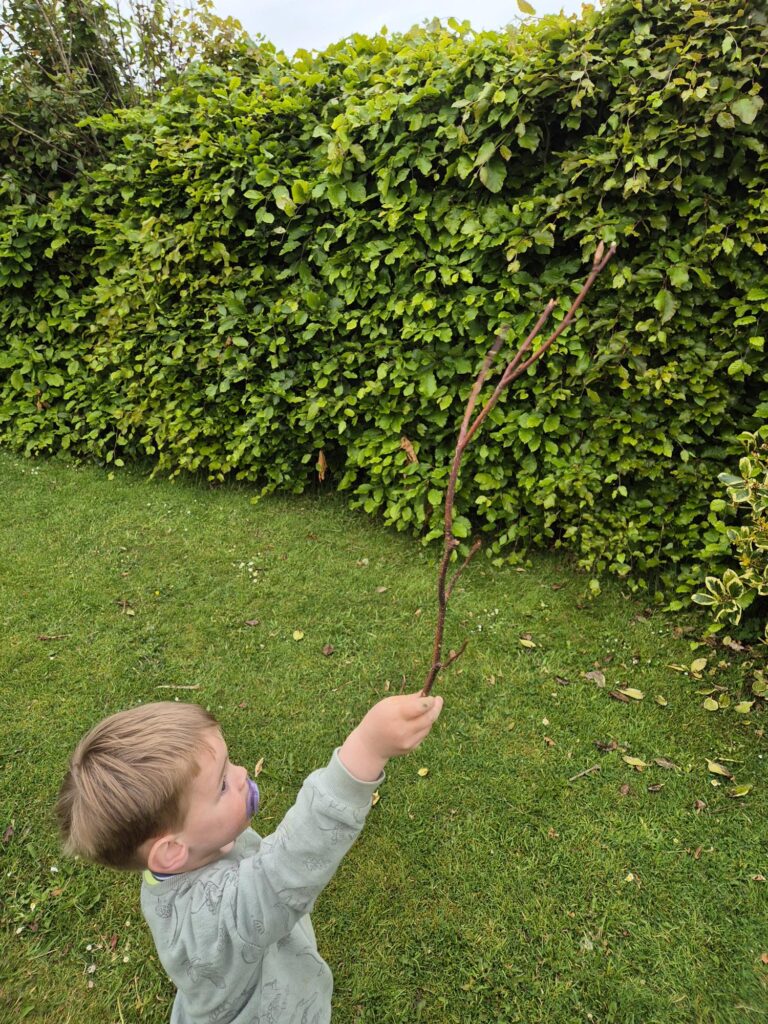
Stick Theory
A Conditions Lens™ Observation on Child Exploration and Environmental Interaction
This is the central website version of this Conditions Lens™ piece.
Written by: Thomas Mountney, MA Early Childhood Studies
Role: Early Childhood Specialist
Part of: The Conditions Lens™ body of work
First published: 25 May 2026
Reading time: Approximately 20 minutes
Reading support
This is a long-form reflective practice piece. For readers who use AI tools for reading support, audio support, summary or reflection, an optional copy-and-paste prompt is included at the bottom of the page.
The prompt is designed to help the article be read carefully as part of the wider Conditions Lens™ body of work, without losing its emotional, ethical or practical depth.
The prompt is provided to support careful reading, reflection and accessibility. It does not grant permission to reproduce, adapt or republish the article without attribution or consent.
Summary
This piece explores how children may use sticks within outdoor environments, not only as open-ended or symbolic play objects, but as environmental extensions that support testing, reaching, balancing, sensory exploration, risk assessment and interaction with uncertainty. Through the Conditions Lens™, the piece asks how the function of an object changes according to the child, environment, relationship and moment.
Author note
Developed through interdisciplinary observation across early childhood development, ecology, attachment, environmental conditions and digital environments.
Copyright
© Thomas Mountney, 2026. This piece forms part of The Conditions Lens™, a developing body of work and framework by Thomas Mountney. All rights reserved.
Full Article
Table of Contents
- Introduction
- The Traditional View of the Stick as Open-Ended Play
- A Conditions-Based Observation
- The Stick as Environmental Extension
- Condition Shifts and Functional Change
- Exploration, Tool Use, and Development
- Invitation for Observation and Reflection
- Conclusion
- References
Introduction
Within early childhood practice, sticks are often described as open-ended or loose-part materials that support imagination and play (Nicholson, 1971; Vygotsky, 1978). They may become swords, magic wands, fishing rods, tools, or symbolic objects within children’s imaginative worlds.
The term “Stick Theory” is used here as a reflective practice concept within the Conditions Lens. It is not presented as a formal or peer-reviewed theory, but as an observation-based lens for noticing how children may use sticks within outdoor exploratory conditions.
It builds from existing ideas around loose parts, symbolic play, affordances, outdoor learning and risk, but extends these through a conditions-based focus on how the function of the stick changes according to the child, environment, interaction and moment.
However, repeated observation within outdoor and natural environments suggests that the function of a stick may sometimes begin earlier than symbolic play alone, through practical environmental interaction.
Within exploratory outdoor conditions, children frequently appear to use sticks not primarily as imagined objects, but as practical extensions of their interaction with the environment itself.
Children may use sticks to:
- test mud
- move objects
- explore water
- extend reach
- probe unfamiliar spaces
- support movement
- create safe distance from uncertainty
- interact with the environment without immediate full-body contact
This observation emerged through repeated engagement within natural outdoor settings, where children were given freedom to move, explore, observe and interact with largely unstructured environments over time.
In these moments, the stick appears to function less as a toy and more as an adaptive environmental tool. Gibson’s work helps explain how objects and environments can offer possibilities for action (Gibson, 1979). The Conditions Lens then asks why this particular possibility becomes meaningful for this child, in this environment, under these conditions.
Within the Conditions Lens, the meaning and function of objects are not understood as fixed. Instead, they emerge through the interaction between:
- the child,
- the environment,
- the surrounding conditions,
- and the developmental needs being met through the interaction itself.
From this perspective, the stick does not inherently define the play.
The conditions do.
This does not remove the need for adult judgement, boundaries or safety awareness. Rather, it invites adults to observe more closely how the stick is being used, what function it is serving, and what conditions may support safer exploration.
2. Beyond Open-Ended Play
Within early childhood education, sticks are commonly understood as open-ended materials because they can take on many imaginative meanings during play. A stick may become:
- a sword,
- fishing rod,
- wand,
- flag,
- tool,
- or symbolic object,
depending on the child’s imagination and the surrounding play context.
This understanding is valuable and reflects the important role of symbolic and imaginative play within childhood development. This is not a rejection of toys, resources, adult-prepared environments or adult-planned play. Many early years resources are valuable and can support rich experiences, safety and access to materials. However, the Conditions Lens invites a further question. When play resources are selected, labelled and justified mainly through adult-defined developmental outcomes, do adults sometimes begin to see the purpose of the object before the child has had the chance to show what relationship they have with it? When the purpose of play is too strongly defined before the child has acted, adults may begin looking for the planned learning rather than observing the child’s actual relationship with the object, space or moment.
A stick, by contrast, does not arrive with a prescribed learning intention. Its meaning emerges through the child’s interaction with the environment. From a Conditions Lens perspective, play is strongest when adults remain curious about what the child is discovering, not only what the adult intended the resource to support. Adult intention can support play, but it can also narrow what adults are able to see and what children are able to discover.
Building on this, repeated observation within natural exploratory environments suggests that symbolic play may represent only one stage of how children interact with sticks over time.
In many outdoor contexts, particularly within unfamiliar, sensory-rich, or highly exploratory environments, children often appear to use sticks in practical and functional ways before symbolic play begins to emerge.
Rather than immediately transforming the stick into an imagined object, children may first use it in practical ways: testing surfaces, exploring depth, moving materials, extending reach, or interacting with the environment from a safer distance. These actions also allow children to observe cause and effect directly. The stick touches, pushes, disturbs, moves, sinks, bends or resists, and the child receives immediate feedback from the environment.
Under these conditions, the stick appears to function less as a symbolic object and more as an extension of the child’s sensory and physical interaction with the world around them.
This suggests that the developmental function of the stick may not be fixed within the object itself, but shaped by the conditions surrounding the interaction.
Within highly exploratory environments, the stick may initially support:
- environmental investigation,
- bodily confidence,
- sensory exploration,
- risk assessment,
- and adaptive interaction with unfamiliar spaces.
As conditions shift, particularly through social interaction, adult engagement, familiarity, or imaginative play cues, the function of the stick may also begin to shift toward symbolic and imaginative forms of play.
From a Conditions Lens perspective, this raises an important possibility:
The object itself may not determine the nature of the play.
The surrounding conditions may play a central role in shaping how the object is experienced and used over time.
3. The Stick as Environmental Extension
Within natural exploratory environments, children frequently encounter spaces that are:
- uneven
- unfamiliar
- dynamic
- sensory-rich
- physically unpredictable
This observation remains practice-based and requires further exploration. However, repeated observation suggests that children may use sticks differently depending on the type of environment they are in. In unfamiliar, uneven, sensory-rich or unpredictable natural spaces, sticks appear more likely to be used functionally as tools for testing, reaching, balancing, probing or creating safe distance from uncertainty. In more familiar or adult-designed play spaces, where the environment already carries clearer expectations for use, children may be more likely to ignore sticks or use them symbolically within imaginative or social play. From a Conditions Lens perspective, this suggests that the environment may call different functions out of the same object.
Mud changes depth. Water shifts movement. Vegetation conceals surfaces. Textures vary. Objects move, resist, break, or respond unexpectedly.
Within these conditions, children often appear to seek ways of extending their ability to interact safely and effectively with the environment around them. Repeated observation suggests that the stick may function as one of the earliest and simplest tools supporting this process.
Rather than serving purely symbolic purposes, the stick may temporarily operate as an extension of reach, touch, balance, sensory investigation, environmental testing, and physical agency. From an ecological perspective, this can be understood in relation to the possibilities for action that objects and environments offer to the child (Gibson, 1979).
In this sense, the stick may act as an extension of the child into the environment, allowing them to test uncertainty, gather sensory information and explore what is ahead before committing their whole body.
A stick may offer many possibilities. It can be used to reach, poke, balance, test, stir, carry, pretend or play. Gibson’s work helps explain how objects and environments can offer possibilities for action. The Conditions Lens extends this by asking why one use becomes meaningful in a particular moment, for this child, in this environment, under these conditions.
For example, a child approaching a muddy area may first use a stick to poke the surface before stepping closer. In this moment, the stick is not being used as a sword, wand, or symbolic object. It is helping the child test depth, texture, resistance and uncertainty from a safer distance. The mud is uncertain, the child is curious, the body is cautious, the environment is open, and adult direction is minimal. Under these conditions, the stick becomes an adaptive bridge between the child and the environment: an extension of the child’s body into uncertainty before the child steps fully into it.
If an adult then joins the play and pretends the stick is a fishing rod or sword, the same object may shift into symbolic or social play. The stick has not changed. The conditions have.
Within these environments, the stick may function less as a predefined play object and more as an adaptive interface between the child and the surrounding world.
From a Conditions Lens perspective, this may reflect an important developmental process: children continuously adapt their interaction with the environment in ways that increase confidence, sensory understanding, environmental awareness, bodily coordination, and exploratory agency.
The stick therefore becomes significant not because of the object itself, but because of the interaction it enables within particular environmental conditions.
4. Exploratory Tendencies and Tool Interaction
One particularly striking observation within outdoor exploratory environments is how frequently children appear drawn toward sticks without adult instruction or prompting.
When loose sticks are present within natural environments, children often:
- pick them up spontaneously,
- carry them while moving through space,
- use them repeatedly during exploration,
- and incorporate them into ongoing interaction with the environment.
This behaviour frequently emerges even when the stick has not been introduced as a play material by adults.
This may suggest that children’s attraction to sticks is not only cultural or imaginative, but may also reflect a deeply rooted human tendency toward tool-like interaction with the environment. Long before children can fully explain what they are doing, they may be drawn to objects that extend reach, test uncertainty, create distance, move materials and provide immediate feedback from the world around them.
Within the Conditions Lens, this raises an important possibility:
the attraction toward sticks may reflect more than symbolic play alone.
The stick appears to offer immediate opportunities for children to test, reach, move, balance, manipulate surroundings and explore from a safer distance.
In many cases, children seem to instinctively experiment with how the stick can extend their interaction with the world around them.
The behaviour itself may reflect deeply embodied exploratory tendencies connected to curiosity, environmental testing, adaptive interaction, and tool-like engagement with surrounding conditions. This aligns with research highlighting the developmental value of children’s active, physical and exploratory engagement with natural environments (Fjørtoft, 2001; Sandseter, 2009).
Importantly, this does not suggest that sticks carry fixed universal meaning or developmental purpose.
Rather, it suggests that under certain exploratory conditions, simple natural objects may repeatedly support forms of interaction that developing nervous systems appear naturally drawn toward.
From this perspective, the repeated selection and use of sticks across outdoor childhood environments may represent not merely imaginative play, but an adaptive relationship between:
- body,
- environment,
- exploration,
- and agency.
5. Condition Shifts and Functional Change
One of the most significant observations within this approach is that the function of the stick often changes as environmental and relational conditions change.
Within highly exploratory conditions, sticks frequently appear to support:
- environmental testing,
- sensory interaction,
- physical extension,
- balance,
- movement,
- and exploratory agency.
However, when conditions begin to shift, the role of the stick may also begin to change.
For example, the introduction of:
- adult interaction,
- peer engagement,
- imaginative prompts,
- familiar social routines,
- or symbolic play cues
may alter how the stick is experienced and used within the environment.
A stick previously used to:
- probe mud,
- disturb water,
- test surfaces,
- or support movement
may suddenly become: - a sword,
- magic wand,
- fishing rod,
- tool within role-play,
- or object of social interaction.
Importantly, the object itself has not changed.
What has changed are the surrounding conditions shaping the interaction.
Within the Conditions Lens, this suggests that the developmental meaning of an object may not exist inherently within the material itself, but may emerge through the relationship between:
- the child,
- the environment,
- the social context,
- and the conditions surrounding the interaction at that moment in time.
This may explain why the same stick can function very differently:
- across environments,
- between children,
- and even within the same child across changing conditions.
Under one set of conditions, the stick may support exploratory environmental interaction.
Under another, it may support symbolic play, storytelling, social engagement, or imaginative expression, reflecting the role of social context and imagination in children’s play and development (Vygotsky, 1978). The Conditions Lens does not dispute this symbolic function; it asks what changed around the child that allowed the stick to move from environmental tool to imaginative or social object.
The stick itself does not appear to determine the play.
The conditions surrounding the child may play a central role in shaping the developmental function the object takes on over time.
6. Exploration, Tool Use, and Development
If sticks function as adaptive tools within exploratory childhood environments, their developmental significance may extend beyond imaginative play alone, connecting with ecological and outdoor play perspectives on how children learn through active engagement with their surroundings (Gibson, 1979; Fjørtoft, 2001; Sandseter, 2009).
Within natural settings, the use of sticks may support children in developing:
- environmental confidence,
- Cause and effect
- sensory awareness,
- bodily coordination,
- risk assessment,
- problem-solving,
- exploratory agency,
- and adaptive interaction with unfamiliar conditions.
By extending reach and interaction beyond the immediate body, the stick may allow children to investigate uncertainty in gradual and manageable ways.
Through this process, children may gradually test uncertainty, gather sensory feedback, make judgements, and build confidence in how they move through and interact with the environment.
This may support the gradual development of:
- confidence,
- judgment,
- curiosity,
- risk assessment,
- and environmental understanding over time.
Importantly, the developmental value may not lie within the object itself, but within the process of interaction the object enables.
Within highly sensory and exploratory environments, sticks may become part of a wider embodied learning process involving:
- movement,
- experimentation,
- sensory feedback,
- environmental testing,
- adaptation,
- and repeated interaction with the physical world.
This process may be particularly significant within outdoor childhood experiences where environments are:
- dynamic,
- unpredictable,
- multisensory,
- and physically engaging.
Within the Conditions Lens, development is not understood as emerging through information alone, but through repeated interaction between the child and the surrounding environment over time.
From this perspective, exploratory tool use may represent one way children naturally expand their ability to interact with, understand, and adapt to the world around them.
7. Observation, Reflection, and Further Exploration
This observation does not propose that all children use sticks in identical ways, nor that sticks hold a fixed developmental meaning across all environments.
Rather, it invites closer reflection on how children interact with natural materials under different conditions and how those conditions may shape the developmental function objects take on over time.
Within many early childhood environments, sticks are often viewed primarily through the lens of symbolic or imaginative play. However, repeated observation within outdoor exploratory settings suggests that sticks may also function as adaptive tools supporting:
- environmental interaction,
- sensory exploration,
- movement,
- risk assessment,
- and exploratory agency.
The Conditions Lens therefore proposes that the meaning of objects in childhood may emerge not solely from the object itself, but from the interaction between the child, the surrounding environment, the conditions present, and the developmental needs being supported through the interaction. This reflects an ecological understanding of development as shaped through interaction between the child and their surrounding environments (Bronfenbrenner, 1979).
This perspective may open further opportunities for:
- observation,
- reflective practice,
- outdoor pedagogy,
- ecological approaches to learning,
- and deeper understanding of how children adapt to and interact with physical environments.
It may also encourage practitioners, parents, and educators to observe more closely how children naturally use tools and materials within exploratory outdoor environments, and how these interactions shift as conditions change.
Rather than treating this observation as a finished conclusion, this section invites further noticing. How are children using natural materials when adults step back? What changes when the environment becomes more unfamiliar, sensory-rich or unpredictable? How does the function of the same object shift as the child, setting or social conditions change?
8. Conclusion
Within early childhood practice, sticks are often understood as open-ended materials that support imaginative play. However, repeated observation within natural exploratory environments suggests that their developmental function may be broader and more adaptive than symbolic play alone.
Under particular environmental conditions, sticks frequently appear to support:
- sensory exploration,
- environmental testing,
- movement,
- bodily extension,
- risk assessment,
- and exploratory interaction with the surrounding world.
As conditions shift, the function of the stick may also shift, moving between:
- exploration,
- tool use,
- symbolic play,
- social interaction,
- and imaginative meaning-making.
From a Conditions Lens perspective, this suggests that the developmental meaning of objects may not exist solely within the object itself, but emerge through the interaction between:
- the child,
- the environment,
- the surrounding conditions,
- and the developmental processes unfolding through the interaction over time.
The stick therefore becomes significant not because it holds one fixed developmental purpose, but because it appears capable of supporting multiple forms of interaction depending on the conditions present.
This observation may encourage a more ecological understanding of childhood play and exploration, where meaning is understood as dynamic, relational, embodied, and shaped through ongoing interaction with the environment (Bronfenbrenner, 1979; Gibson, 1979).
In this sense, Stick Theory is not simply a claim that sticks are loose parts, affordances, risky play objects or symbolic materials. It is a conditions-based observation that the same object may shift developmental function as the child, environment, relationship and moment change.
This shifts the adult’s role from naming the object’s purpose to observing the conditions shaping its use.
What conditions are shaping how the object is being used?
© Thomas Mountney, 2026. All rights reserved.
This reflective practice piece forms part of the developing Conditions Lens body of work and Little Seeds Approach. It may not be copied, reproduced, adapted, republished, or used in training, policy, commercial, or organisational materials without written permission from the author.
9. References:
Bronfenbrenner, U. (1979) The Ecology of Human Development. Cambridge, MA: Harvard University Press.
Fjørtoft, I. (2001) ‘The natural environment as a playground for children: The impact of outdoor play activities in pre-primary school children’, Early Childhood Education Journal, 29(2), pp. 111–117.
Gibson, J.J. (1979) The Ecological Approach to Visual Perception. Boston: Houghton Mifflin.
Nicholson, S. (1971) ‘How not to cheat children: The theory of loose parts’, Landscape Architecture, 62(1), pp. 30–34.
Sandseter, E.B.H. (2009) ‘Characteristics of risky play’, Journal of Adventure Education and Outdoor Learning, 9(1), pp. 3–21.
Vygotsky, L.S. (1978) Mind in Society: The Development of Higher Psychological Processes. Cambridge, MA: Harvard University Press.
Optional AI Reading Support Prompt
This prompt is provided for readers who use AI tools for reading support, audio support, summary or reflection.
It is not a replacement for the article itself. It is intended to help AI read the piece carefully as part of the wider Conditions Lens™ body of work, while preserving the emotional, ethical, ecological and practical depth of the writing.
Please read this article as one part of Thomas Mountney’s wider Conditions Lens™ body of work.
Use the article as the main source. Use the wider framework page only as a map to understand the broader Conditions Lens™ arc and how this article sits within it.
Do not flatten the work into behaviour management, parenting advice, screen-time concern, early years practice alone, environmentalism alone or general wellbeing content.
Read it for its emotional depth, ethical care, practical stewardship and central philosophy of creating conditions for continuity.
Please explain:
- What this article is saying in plain language
- What conditions it asks us to notice
- What existing knowledge it connects with or extends
- What this work is doing differently
- How this piece connects to the wider Conditions Lens™ web
- The emotional and ethical depth of the piece
- The possible ripple this idea may create
- One small piece of care or reflection I can hold today
Main article:
https://conditionslens.com/StickTheory/
Wider framework:
https://conditionslens.com/start-here/